|
1
|
- Institute of Company Secretaries
- 34 th National Convention September 8, 2006
- Dilip M. Sarwate Ph.D. CMC FIMC
|
|
2
|
|
|
3
|
- Scientific management ( Time & motion studies)
- Cost accounting and variance analysis
- The commercial research laboratory the industrialization of science)
- ROI analysis and capital budgeting
- Brand management
- Large scale project management (PERT/CPM)
- Divisionalization
|
|
4
|
- Leadership development
- Industry consortia ( Multi company collaborative structures)
- Radical decentralization (Self organization)
- Formalized strategic analysis
- Employee driven problem solving (Quality Circles, Kaizan)
- Reference: The Why, What and How of Management Innovation by Gary Hamel
February 2006 Harvard Business Review
|
|
5
|
- Business Process Re-engineering
- Core competency
- Balance Score Card
- Emotional intelligence
- Competitive intelligence
- Knowledge management
- Intrapreneurship
- Theory X, Y & Z and many others
|
|
6
|
|
|
7
|
|
|
8
|
- The second largest B-School in Europe
|
|
9
|
|
|
10
|
- Well explored and crowded with competitors
- New ways to cut costs and grow revenue (Outsourcing, value engineering)
- Take away market share from competitors (Offer incentives)
|
|
11
|
- Generic growth strategies
- Competitive advantage
- Competitive strategy
- Competitive advantage of nations
- And many others
|
|
12
|
- Strategy is King
- The word comes from Military
- It is all about red ocean competition
- It is about confronting an opponent and driving him off a battlefield of
limited territory
- Competitive advantage is at the helm of strategy
- Decision variables to fulfill the organizational objectives
|
|
13
|
- Denotes all the industries not in existence today-the unknown market
space, untainted by the competition. Here the demand is created rather
than fought over. There is ample opportunity for growth that is both
profitable and rapid. Two options are,
- Give rise to completely new industries
- From within a red ocean, when a company alters the boundaries of an
existing industry
|
|
14
|
- Entertainment electronics- Sony Walkman, Flat TV’s
- Mutual funds
- Cellular telephones
- Biotechnology
- Express package delivery – Federal Express
- Coffee bars- Star Bucks
- Home videos
- e-Bay- Consumer to consumer selling
- Hybrid passenger cars- Toyota and Honda
|
|
15
|
- Child restraints (Baby car seats)
- e-Learning
- Digital books (Stephen King)
- Optic fibers
- I-pod
- Animation films (Shrek, Cars)
- Mortgage Mantra (Internet based software for buying property)
- Fuel cells and many others
|
|
16
|
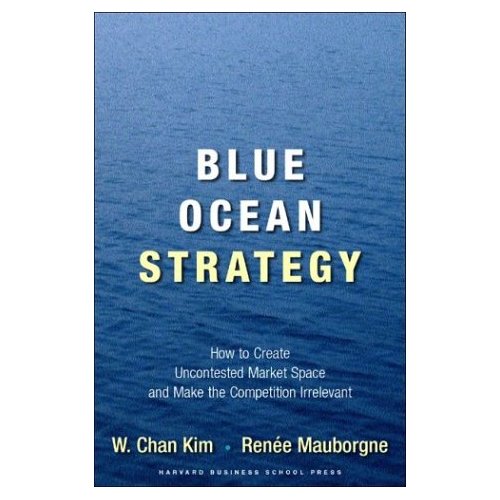
- Red ocean strategy
- Compete in existing market space
- Beat the competition
- Exploit existing demand
- Make the value/cost tradeoff
- Align the whole system of a company’s activities with its strategic
choice of differentiation or low cost
- Blue ocean strategy
- Create uncontested market space
- Make competition irrelevant
- Create new demand
- Break value/cost trade off
- Align the whole system of a company’s activities in pursuit of both differentiation and low cost
|
|
17
|
- Reconstruct market boundaries. Strategically examine your industry’s key
competitive drivers
- Focus on the big picture and not merely the numbers. Consider the
competitive environment through your customer’s eyes so that you stay
focused on what matters to them
- Reach beyond existing demand. Do not just focus on your current
customers. Look for your potential customers.
|
|
18
|
- Get strategic sequence right. Technological innovation does not
guarantee marketing success. The technology must be made relevant to
customer and provide value
- Overcome key organizational hurdles
- Build execution into strategy. Link engagement, explanation and
expectation with the actual process of developing the strategy.
Executing a blue ocean strategy will require a trust among your team
|
|
19
|
- Perhaps nothing. Is it just the “ old wine in new bottle’’?
|
|
20
|
- The opportunities attract competitors
|
|
21
|
- More consumption
- New users
- New usage
- New geographical markets
- New applications
- Product innovation – Maximization or minification
|
|
22
|
|
|
23
|
- Customer orientation
- Integrated marketing
- Generating customer satisfaction
- Achieving organizational and social objectives
|
|
24
|
- As members of Strategic Management Team,
- They have to look for new market opportunities on their own or through
strategic alliances globally
- Encourage product innovation keeping in view the Intellectual Property
Rights
- They must come with a Competitive Strategy which will not infringe the
Competitive Act.
- Aim at creating excellence as viewed from the eyes of all stake holders
- Enforce Corporate Governance
- Invest in Competitive Intelligence on global markets
- Create a Competitive Advantage for their Company
|
|
25
|
|

 Notes
Notes