|
1
|
- Impact of Global Developments on Corporate Governance
- Varsha Marathe
- The World Bank
- September 2006
|
|
2
|
- Why corporate governance?
- Impact of Global Developments on Corporate Governance
- Common trends and lessons learned
- World Bank’s role in corporate governance
- From diagnostic to implementation
|
|
3
|
- Protection of shareholder rights
- Public policy rationale
- Access to finance
- Crisis prevention and financial stability
- Protection of pension savings for retirement
|
|
4
|
|
|
5
|
- Crises and Bankruptcies
- East Asian and Russian Financial Crisis
- Scandals involving major corporates in the US and Europe
- Response
- Financial Stability Forum (1999)
- Review and changes to company law have tightened audit functions,
increased transparency, and improved the role of shareholders
- Stringent requirements from regulators on compliance e.g. SOX
- Codes of corporate governance
|
|
6
|
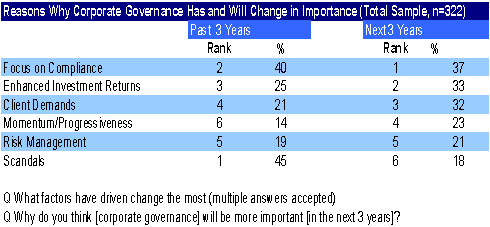
- Drivers of Corporate Governance
- Corporate Scandals
- Increased focus on Compliance
- From compliance it is now a business imperative
- Globalizing forces
- speed of globalization of corporate governance practices with a lot of
‘copy-cat’ tactics”
- globalization of corporate governance also holds implications for
regulators and governments, especially in developing markets.
|
|
7
|
- Corporates
- Recognize the global pressure to raise corporate governance practices,
often to standards that are higher than those prevailing in the
issuer’s home market
- Build on best practice to attract and expand international shareholder
base and lower cost of capital
- Improving the skills mix to respond to the requirement of global
governance
- Government/Regulators
- As markets compete for global capital, corporate governance standards
is an important driver.
- Governments and regulators are encouraging higher corporate governance
standards to make their markets more attractive to international
investors.
|
|
8
|
- The Corporate Form is universal - limited liability, unlimited life,
legal personality, separation of ownership and control
- Certain basic principles apply in all countries:
- I) The Rights of Shareholders;
- II) The Equitable Treatment of Shareholders;
- III) The Role of Stakeholders;
- IV) Disclosure and Transparency;
- V) The Responsibilities of the Board.
- International and Regional Dialogue use OECD Principles as Conceptual
Framework (Codes, Roundtables; FSF)
|
|
9
|
- On the one hand…
- Acceptance of corporate governance and OECD Principles
- Large amount of reform activity over the past 3-5 years
- Lowered thresholds for shareholder action
- Greatly improved disclosure rules, standards, and formats
- Concepts of “independent director” and audit committee
- Efforts at improving director training
- More active regulators and exchanges
|
|
10
|
- On the other hand …
- Understanding ownership remains difficult in many countries
- Reforms are just beginning to penetrate business cultures
- Disclosure and approval of related party transaction
- Quality of financial reporting still mixed
- True board independence remains rare; “rubber stamp” boards
- “Reform fatigue”
- Enforcement remains key challenge
|
|
11
|
- Investment Climate
- One of the World Bank’s strategic pillars
- Macro-stabilization and micro policy reforms
- Laws, regulations, public institutions and civic habits
- Importance of diagnostics – investment climate assessments, doing
business database, corporate governance assessments
- èA conducive investment
climate is crucial for economic growth and poverty reduction
|
|
12
|
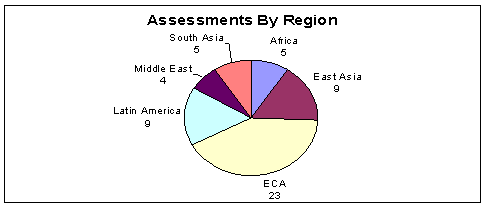
- Country participation is voluntary
- Assessments are benchmarked against the OECD Principles of Corporate
Governance
- Standardized and systematic diagnostic, including policy recommendations
- Updates: measure progress over time
- Publication (voluntary) at: http://www.worldbank.org/ifa/rosc_cg.html
|
|
13
|
|
|
14
|
|
|
15
|
- What has been achieved in corporate governance?
- Significant legal and regulatory reforms
- Improvements in the level of responsibility/accountability of insiders,
fairness in the treatment of minority shareholders and stakeholders,
board practices, and transparency
- Key challenges in implementing corporate governance reform agenda
- Stricter enforcement by the regulators and stock exchanges
- Improved delisting rules
- Clarification of responsibilities on the regulatory architecture
- Creation of a credible director training institution
- Active institutional investors
- Way forward
- Corporate governance of banking institutions and state owned
enterprises
- Corporate governance of non-listed companies
- Reforms to deal effectively with director liability in case of
conflict-of-interest situation benefiting a controlling
shareholder-director
|
|
16
|
|
|
17
|
|

 Notes
Notes